

Scaling in 2026 requires more than generic tools. Discover why a custom software development company is the key to business survival, from revolutionary custom software development for healthcare to local excellence with a custom software development company in USA.
This is happening right now: companies that relied on generic subscriptions in 2024 are finding themselves trapped in “SaaS debt,” paying for features they don’t use while lacking the specific AI integrations they desperately need. In 2026, the gap between the leaders and the laggards is defined by who owns their code. If you aren’t partnering with a top-tier custom software development company, you aren’t just falling behind—you are losing your data autonomy.
The Great Repatriation of Code
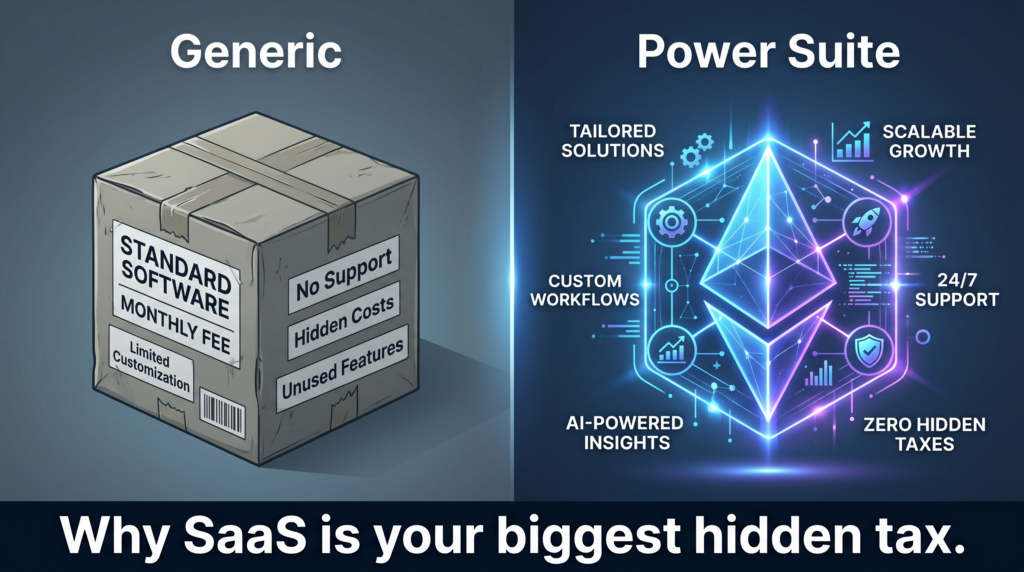
For years, the trend was to “outsource to the cloud.” Today, we are seeing a massive “code repatriation.” Enterprises are seeking a custom software development company in USA to build in-house, secure, and hyper-efficient platforms that they actually own. The goal? Escaping the rising costs of seat-based licensing and reclaiming the 20% of revenue usually lost to inefficient workflows.
Custom Software Development for Healthcare: A Matter of Life and Death
The sector seeing the most radical change is medicine. In 2026, the “Standard Electronic Health Record” is no longer enough. Modern clinics require custom software development for healthcare that integrates biometric wearables, predictive AI diagnostics, and blockchain-secured patient histories.
Why the Stakes are Higher in 2026
With the implementation of the 2026 Global Health Data Act, compliance is no longer a checkbox; it is an automated, real-time requirement. Generic software cannot keep up with these localized legal shifts. Healthcare providers are now turning to specialized developers to create “Digital Twins” of patient outcomes—a feat only possible through bespoke architecture.
The Human Impact
It isn’t just about the money. Custom-built diagnostic tools are reducing misdiagnosis rates by 14% globally. When software is built for the specific workflow of a surgeon rather than a generic office clerk, the results are measured in lives saved.
The Rise of the Custom Software Development Company in USA
While offshore development remains popular for low-level maintenance, the demand for a custom software development company in USA has hit a ten-year high. Why? Proximity, Security, and Strategic Alignment.
Strategic Partnership vs. Ticket Takers
In the 2026 economy, you don’t need a coder; you need a product strategist. Domestic companies are excelling because they understand the complex interplay of American labor laws, consumer psychology, and the hyper-local AI regulations appearing in states like California and Texas.
Security in a Post-Quantum World
As quantum computing begins to threaten traditional encryption, having a local partner to architect “Quantum-Resistant” security protocols is becoming a non-negotiable insurance requirement for US-based firms.
The ROI Factor: Hidden Financial Benefits of Custom Tech
Most CEOs look at the price tag of custom builds and flinch. However, they ignore the “Compound Interest of Efficiency.” A custom software development company doesn’t just build an app; they eliminate manual labor.
Eliminating “Shadow IT”
When your software actually works, your employees stop using unauthorized (and dangerous) third-party apps to get their jobs done. This centralizes data and slashes the risk of multi-million dollar breaches.
Scalability Without the “Success Tax”
With SaaS, as you grow, your bill grows. With custom software, your biggest expense is upfront. Once the platform is built, scaling from 1,000 to 1,000,000 users doesn’t exponentially increase your licensing fees. This is the “Opportuntity Hidden” in plain sight: Custom code is the only way to decouple growth from overhead.
10 Actionable Dips for Choosing a Custom Software Development Company
- Demand an “AI-First” Strategy: If they aren’t talking about LLM integration and neural networks, they are living in 2022.
- Check for Industry Verticality: A developer who builds e-commerce sites might fail at custom software development for healthcare.
- Ownership of IP: Ensure the contract explicitly states you own the source code, not just a license to use it.
- Post-Launch Support: 2026 software requires constant security patching. Never sign a “Build and Goodbye” contract.
- User Experience (UX) for Employees: Internal tools should be as intuitive as Instagram. If it’s hard to use, your staff won’t use it.
- Interoperability: Ensure the new system “talks” to your existing legacy data via robust APIs.
- Data Sovereignty: Verify where the data is physically stored. In 2026, geography is destiny for data laws.
- Agile is the Minimum: Look for “Continuous Integration/Continuous Deployment” (CI/CD) workflows.
- Scalability Stress Tests: Ask for proof of how the architecture handles traffic spikes.
- The Culture Fit: You are entering a marriage. If their communication style clashes with your team, the project will fail.
Common Errors: Why 60% of Custom Projects Still Fail
- The “Feature Creep” Trap: Trying to build everything at once. Start with a Minimum Viable Product (MVP).
- Underestimating Migration: Moving data from old systems is often harder than building the new one.
- Choosing the Lowest Bid: In software, a “cheap” build usually results in a complete rebuild 18 months later.
- Poor Stakeholder Feedback: Building what the CEO wants, but not what the actual daily users need.
The Secret Strategy: The “Micro-SaaS” Pivot
Little known to many, some of the most profitable companies in 2026 are hiring a custom software development company to build internal tools—and then licensing those tools to their competitors. This turns an IT cost center into a high-margin revenue stream.
FAQ: Navigating the 2026 Tech Landscape
1. Is custom software more expensive than SaaS in the long run? No. While the initial investment is higher, the lack of monthly per-user fees and the increase in operational efficiency usually result in a break-even point within 18–24 months.
2. Why is custom software development for healthcare so specialized? Because of “Data Gravity” and HIPAA/GDPR. Medical data requires specific audit trails and encryption layers that generic software simply isn’t built to handle.
3. How long does a typical build take with a custom software development company in USA? An MVP usually takes 3 to 6 months. Full enterprise ecosystems can take 12+ months, depending on complexity.
4. Can I integrate AI into my existing custom software? Yes, 2026 is the year of “AI Retrofitting,” where developers add neural layers to older proprietary codebases.
5. What is the biggest risk of custom development? “Vendor Lock-in” where only the original developer understands the code. You can avoid this with proper documentation and clean coding standards.
6. Does custom software help with SEO? Indirectly, yes. Faster, more responsive internal and external tools improve Core Web Vitals, which is a significant ranking factor for Google.
7. Should I hire a boutique firm or a large agency? Boutique firms offer more senior-level attention; large agencies offer more “horsepower” and diverse talent pools.
8. What language is best for 2026 software? Python remains king for AI, while Rust and Go are preferred for high-performance, secure backend systems.
Conclusion: The Choice is Yours
As we move further into 2026, the digital world is splitting in two. On one side are the “Renters”—companies paying forever for mediocre software they don’t own. On the other are the “Owners”—those who partnered with a custom software development company to build an impenetrable moat around their business. The opportunity is here, but the window for total digital sovereignty is closing fast.
Reliable Sources:

Café Codificado é um portal dinâmico e confiável criado especialmente para desenvolvedores. Nosso foco é entregar:
Dicas práticas para programação, produtividade, frameworks, testes, DevOps e muito mais;
Notícias atualizadas, acompanhando tendências e lançamentos do mundo da tecnologia, compiladas com relevância e sem jargões desnecessários.
O que você encontra aqui:
Artigos objetivos e comandáveis — Tutoriais, tutoriais passo-a-passo e dicas que vão direto ao ponto.
Cobertura das tecnologias que estão em alta — do universo da IA, computação em nuvem e segurança à engenharia de software e criatividade em código.
Conteúdo para todos os níveis — de iniciantes buscando praticidade, a profissionais em busca de insights estratégicos e aperfeiçoamento.
Comunidade ativa — textos humanizados, perguntinhas instigantes e espaço para você contribuir com reflexões e comentários.