

Featured Snippet Summary: In 2026, the enterprise ai implementation consulting cost typically ranges from $500,000 to over $2 million for comprehensive, large-scale systems. While basic automation pilots start at $50,000, high-impact enterprise ai solutions requiring custom model tuning, data sovereignty, and “Agentic AI” integration demand significant investment. Total cost of ownership (TCO) over three years is often 1.5x to 2x the initial setup, driven by ongoing model maintenance and workforce upskilling.
The $2.5 Trillion “Efficiency Chasm” of 2026
We have officially entered the era of the $2.5 trillion AI economy. According to Gartner’s 2026 Forecast, global AI spending has hit record highs, but a dangerous “Efficiency Chasm” has emerged. On one side are the “AI-Native” enterprises that are slashing operational costs by 40%. On the other are companies bleeding capital on failed pilots and “Shadow AI.”
In 2026, the question isn’t whether to implement enterprise ai, but how much the wrong implementation will cost you. As labor costs rise and the productivity mandate becomes a matter of survival, understanding the true enterprise ai implementation consulting cost is the difference between a high-yield asset and a sunk-cost nightmare.
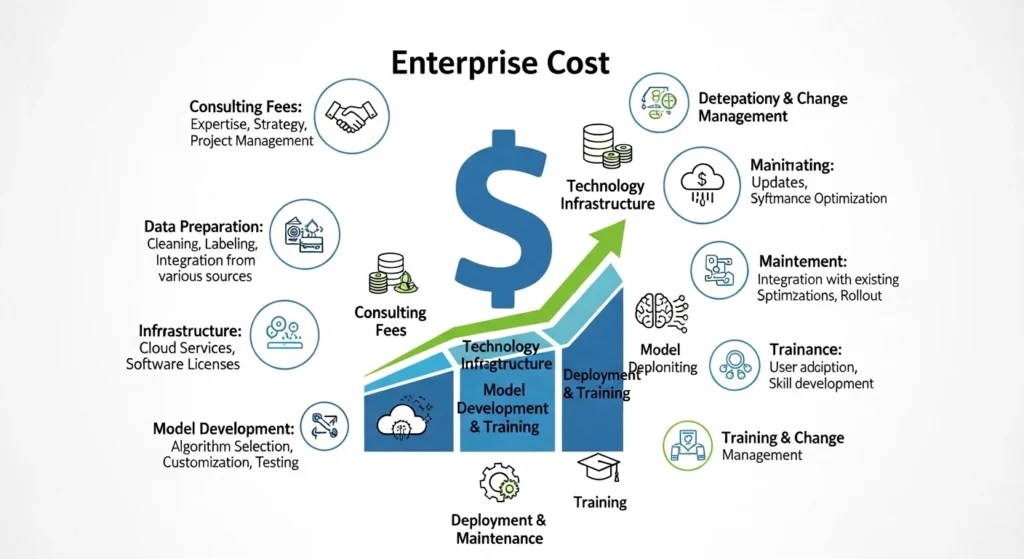
Breaking Down the Enterprise AI Implementation Consulting Cost in 2026
The market for AI consulting has matured. Gone are the days of vague “experimental” fees. Today, pricing is tied to complexity, data readiness, and the shift toward Agentic AI—systems that don’t just suggest, but execute.
1. The Strategy & Readiness Audit ($50k – $150k)
Before a single line of code is written, top enterprise ai solution providers conduct deep-dive audits. This phase covers data lineage, regulatory compliance, and identifying high-ROI use cases. In 2026, “Context Engineering” has replaced simple prompt engineering as a core, billable expertise.
2. Custom Model Development & Tuning ($300k – $1M+)
While foundation models are cheaper, enterprise ai requires domain-specific training. Using proprietary data to create a “Vertical AI” solution for healthcare, finance, or logistics adds significant cost but delivers 50% better performance than generic tools.
3. Infrastructure & Governance Integration ($200k – $500k)
Security is the biggest cost multiplier in 2026. Setting up a secure enterprise ai solution that respects data sovereignty and local regulations (like the EU AI Act or Brazil’s LGPD updates) can add 30-40% to the baseline implementation budget.
Why Agentic AI is Driving 2026 Consulting Fees
The buzzword of 2026 is “Agentic AI.” Unlike the static chatbots of 2024, these agents are autonomous. They plan, reason, and interact with your ERP and CRM systems.
Implementing these agents requires a sophisticated level of enterprise ai implementation consulting because they require “Human-in-the-Loop” (HITL) safety protocols. The complexity of mapping these autonomous workflows into existing business processes is what separates a $100k chatbot from a $1M enterprise ai solution.
The Hidden Costs: ROI and the Workforce Gap
A shocking DataCamp 2026 Report reveals that while investment is soaring, only 21% of leaders report “significant” positive ROI. Why? Because they underestimated the “Workforce Gap.”
The “1.5x TCO” Rule
For every dollar spent on the enterprise ai implementation consulting cost, savvy CEOs are now budgeting an additional 50 cents for “AI Literacy” programs. In 2026, 72% of enterprise leaders say AI literacy is as fundamental as reading and writing. Without it, your expensive AI platform becomes “shelfware.”
Benefits vs. Risks: The High-Stakes Choice
Benefits:
- Cost Reduction: Automated workflows in 2026 reduce human error and overhead by an average of 35%.
- Decision Intelligence: Real-time predictive insights allow for faster pivots in a volatile economy.
- Hyper-Personalization: Scaling customer journeys that feel human but are 100% automated.
Risks:
- Model Drift: AI performance degrades over time. Continuous maintenance adds 20-30% to annual budgets.
- Regulatory Penalties: High-cost consulting often includes “Governance-as-a-Service” to avoid massive fines.
10 Actionable Tips to Optimize Your AI Consulting Budget
- Define “Narrow” Use Cases: Don’t automate “the company”; automate “claims processing” or “supply chain forecasting.”
- Audit Data Before Hiring: High enterprise ai implementation consulting cost often stems from consultants spending months cleaning your dirty data.
- Prioritize “Modular” Solutions: Build in blocks so you can swap out models as better ones emerge in 2027.
- Demand “Performance-Based” Pricing: Tie consulting fees to measurable KPIs like “Time Saved” or “Lead Quality.”
- Focus on Open-Source Foundations: Utilizing Llama 4 or similar models can cut initial licensing costs by 40%.
- Insist on On-Device Training: Keep sensitive IP off third-party servers to reduce long-term risk.
- Budget for “Upskilling” from Day 1: If your team can’t use the tool, the ROI is zero.
- Automate Governance: Use AI to monitor your AI—it’s cheaper than manual audits.
- Check for Industry Verticality: Hire consultants who specialize in your niche, not generalists.
- Build a “Sandbox” First: A $75k pilot can save you from a $2M mistake.
5 Common Errors in Enterprise AI Spending
- Treating AI as a “Tech Project”: It’s a business transformation project. If the CEO isn’t involved, it fails.
- Over-buying Licenses: Most companies pay for 40% more AI capacity than they actually use.
- Ignoring Shadow AI: Employees using unauthorized tools creates massive security gaps that cost millions to fix later.
- Underestimating Integration: 60% of the enterprise ai implementation consulting cost is usually spent just making the AI “talk” to legacy systems.
- Failing to Retrain Models: An AI trained in January 2026 might be hallucinating by July 2026 due to market shifts.
Strategy: The “Hybrid Core” Approach
Leading firms are adopting the “Hybrid Core” strategy. This involves using a low-cost general-purpose AI for 80% of routine tasks and reserving high-cost enterprise ai solution consulting for the 20% of tasks that provide a competitive moat—such as proprietary R&D or unique customer sentiment analysis.
What Leaders Are Asking About AI Costs in 2026
1. Why is enterprise ai implementation consulting cost so high in 2026? Complexity and security. We are no longer doing “toys”; we are doing “agentic” systems that handle core business logic and sensitive data.
2. Can we use off-the-shelf enterprise ai solutions instead of consulting? Only for generic tasks. For anything using proprietary data or requiring legacy integration, consulting is a mechanical necessity.
3. What is the average timeframe for a $1M implementation? Typically 6 to 12 months, including the “cultural adoption” phase.
4. How do I choose the best enterprise ai implementation partner? Look for “Proof of ROI” in your specific industry and a clear framework for AI governance.
5. Does AI consulting help with 2026 compliance? Yes. A major part of the cost now includes building “Explainable AI” (XAI) to meet regulatory transparency requirements.
6. Is ROI faster in 2026 than in 2024? Yes, because the tools are more mature, but the “usage gap” (employees not knowing how to use them) is still a major hurdle.
7. Should we build in-house or outsource? In 2026, a “Co-Sourcing” model is best: let consultants build the core and have your internal team manage the “MLOps” (Operations).
8. What is the biggest hidden cost of enterprise ai? Data preparation. It typically accounts for 40% to 60% of the total project budget.
Lead the Transformation or Watch from the Sidelines
In 2026, the enterprise ai implementation consulting cost is a strategic investment in the future of your company’s intelligence. While the price tag can be daunting, the cost of obsolescence is far higher. By focusing on enterprise ai solutions that are secure, agentic, and human-centered, you aren’t just buying software—you are buying the ability to scale at a speed that was impossible just two years ago.
Ready to bridge the Efficiency Chasm? Start by auditing your data maturity today.

Café Codificado é um portal dinâmico e confiável criado especialmente para desenvolvedores. Nosso foco é entregar:
Dicas práticas para programação, produtividade, frameworks, testes, DevOps e muito mais;
Notícias atualizadas, acompanhando tendências e lançamentos do mundo da tecnologia, compiladas com relevância e sem jargões desnecessários.
O que você encontra aqui:
Artigos objetivos e comandáveis — Tutoriais, tutoriais passo-a-passo e dicas que vão direto ao ponto.
Cobertura das tecnologias que estão em alta — do universo da IA, computação em nuvem e segurança à engenharia de software e criatividade em código.
Conteúdo para todos os níveis — de iniciantes buscando praticidade, a profissionais em busca de insights estratégicos e aperfeiçoamento.
Comunidade ativa — textos humanizados, perguntinhas instigantes e espaço para você contribuir com reflexões e comentários.